
“How can I help my child with reading practice at home?”
Goodness gracious! If I have heard that question once, I have heard it a thousand times. And honestly, I love it.
I love everything behind that question. It means that student has parents who care about their child’s success, families who want to spend quality time together, and caregivers who are willing to invest their time and energy into helping a child learn to read.
When parents ask if I send homework home, my answer is yes… kind of.
I do send reading practice home, but I do not think of it as homework in the traditional sense. Instead, I think of it as an opportunity for students to build confidence, strengthen the skills they are learning at school, and experience success as readers.

Why Reading Practice at Home Matters
Over the years, I have worked with many families who wanted to support their child’s reading at home but simply did not know where to start. Others were spending lots of time reading together, but were not always using materials that matched their child’s current reading abilities.
As teachers, one of our jobs is to help bridge that gap.
Reading practice at home can be incredibly powerful when students are given text that matches the phonics skills they have already been taught. When children can successfully apply what they know, they begin building the automatic word recognition that leads to fluent reading.
What Parents Can Do to Support Reading at Home
One of the first things I created was a simple parent handout with practical tips families could use to support reading development at home. If you would like to get started, be sure to grab the free parent tips handout below!
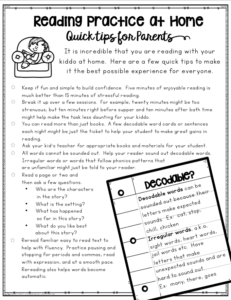
Click here to download the PDF Tips for Parents
The most important takeaway is this: beginning readers need opportunities to practice reading text they can actually decode.
While listening to stories read aloud is incredibly valuable for building vocabulary and language comprehension, students might also benifit from chances to practice the phonics patterns and high-frequency words they are learning in school.
Why I Send Home Decodable Reading Passages
Each week, I send home a reading passage that coordinates with the book or phonics skill we are working on in small groups. These passages provide targeted practice that matches students’ current learning.
Most importantly, the passages are completely optional. Students are never penalized if they do not complete them at home.
Before a passage ever goes home, we read it together during small-group instruction. Ideally, this happens early in the week.
During our lesson, we:
- Preview the text
- Review the phonics patterns students will encounter
- Practice any heart words or high-frequency words
- Read the passage together
- Discuss any tricky parts
By the time students take the passage home, they have already experienced success with it. They are not encountering it for the first time around the kitchen table.
This is an important Science of Reading principle. Students build confidence when they can successfully apply the skills they have already learned rather than being asked to guess at unfamiliar words.
The Power of Repeated Reading
After we read the passage together, students take it home and reread it throughout the week.
Repeated reading gives students multiple opportunities to strengthen the connections between the sounds they hear, the letters they see, and the words they recognize. Over time, these repeated successful encounters help support orthographic mapping—the process that allows words to become stored for instant recognition.
As students become more familiar with the text, their reading naturally becomes smoother and more automatic.
That is exactly what we want.
What About Timed Reading?
For many years, I included a place on the passage for students to record how long it took them to read the text each day.
One thing I noticed was that nearly every student improved from Monday to Friday. Sometimes the growth was small. Sometimes it was significant. But almost every child could see evidence of their progress.
And for beginning readers, that matters.
The biggest benefit was not actually the faster reading.
It was the confidence.
I cannot count the number of times I heard something like:
“Mrs. Darling, I thought this was hard, but look how fast I can read it now!”
That feeling of success is powerful.
Now, when we think about fluency instruction through a Science of Reading lens, it is important to remember that speed is not the ultimate goal. Accuracy, automatic word recognition, expression, and comprehension all matter.
For that reason, I encourage families to focus on reading the passage accurately and smoothly rather than racing against a timer. If timing motivates a child and keeps reading fun, it can certainly be used thoughtfully. However, the goal is always confident, accurate reading—not speed for speed’s sake.
The Best Reading Practice Is Successful Reading Practice
If there is one thing I hope parents take away, it is this:
The best reading practice at home is reading that allows children to experience success.
When students practice with text that matches the phonics skills they have been taught, they build accuracy, fluency, confidence, and a stronger foundation for future reading growth.
And when children feel successful, they are much more likely to see themselves as readers.
That is the kind of magic worth creating.

Frequently Asked Questions About Reading Practice at Home
How long should my child read at home each day?
Quality matters more than quantity. For beginning readers, even 10–15 minutes of focused reading practice can make a big difference. The goal is to create a positive reading experience that builds confidence and reinforces the skills your child is learning at school.
What should my child read at home?
Beginning readers benefit most from reading text that matches the phonics skills they have already learned. Decodable books and passages give children opportunities to practice sounding out words using the patterns they know rather than guessing. Of course, listening to read-alouds and enjoying picture books together is important, too!
Should I correct my child when they make a mistake?
Yes, but gently. If your child makes an error, encourage them to look closely at the word and use the sounds they know to figure it out. Instead of immediately giving them the word, try prompting with questions like:
- “What sound does that letter make?”
- “Can you try that word again?”
- “Does that look right?”
The goal is to help children develop problem-solving skills and confidence as readers.
Are decodable books better than leveled readers?
For beginning readers who are learning phonics, decodable texts provide practice with the specific letter-sound relationships they have been taught. Research shows that students benefit from opportunities to apply their phonics knowledge in connected text. As children become more proficient readers, they can enjoy a wider variety of books and texts.
What if my child doesn’t want to read at home?
Keep reading time short, positive, and encouraging. Celebrate effort and growth rather than perfection. Let your child reread familiar texts, read to a stuffed animal, read with a sibling, or take turns reading with you. The goal is to build confidence and create positive experiences around reading.
Is repeated reading really helpful?
Yes! Repeated reading gives children multiple opportunities to practice the same words and phonics patterns. As reading becomes more automatic, children can focus less on figuring out individual words and more on understanding what they are reading. Repeated reading can improve accuracy, fluency, and confidence.
Should my child time their reading?
Timing can be motivating for some children, but it should never create stress or pressure. The goal is not to read as fast as possible. Instead, focus on accurate, smooth, and expressive reading. If your child enjoys tracking their progress, occasional timing can be a fun way to celebrate growth and increased automaticity.



No Comments