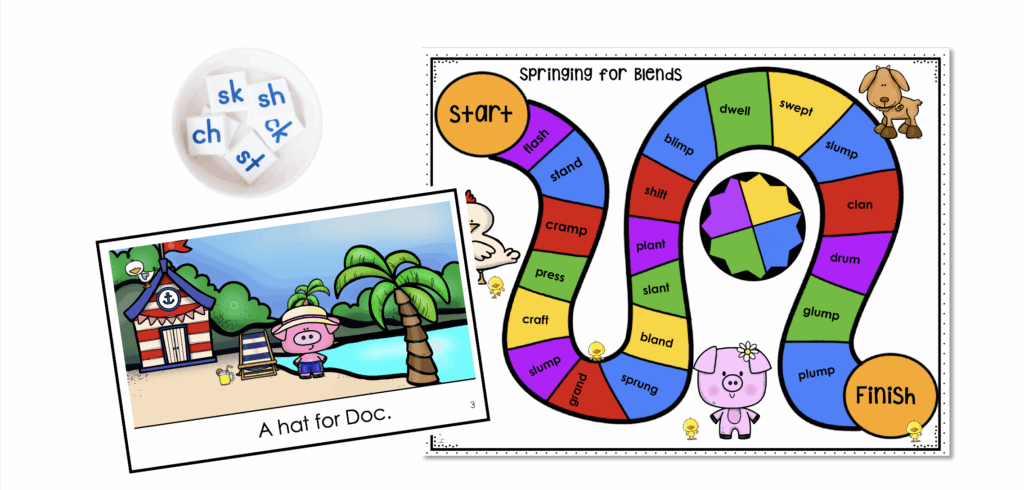
If you’re using decodable readers in your Science of Reading small groups, you’ve already taken an important step toward giving students reading practice that aligns with the Science of Reading.
But one question comes up all the time:
How do I actually use decodable readers during small group instruction? When I first began, that question always created a bit of overwhelm in me. Sound familiar?
The good news is, once you get into your rhythm, it becomes easier than you think! And it’s worth it. There is so much research out there about whole vs small group instruction and which one is better for students. As a kinder teacher of 5 years and a special education teacher of 9 years, I say both!
That’s why I want to I’ll walk you through exactly how I use the decodable sets in my Decodable Readers Bundle and how you can use them to create meaningful Science of Reading-aligned small groups. This small group bundle was created so I and other teachers didn’t have to recreate the wheel and spend endless hours planning out small groups (and fighting overwhelm at the same time!) But this routine can be done with almost any decodable text as well!
Step 1: Group Students by Skill, Not Reading Level
One of the biggest shifts many teachers make when learning to implement decodable readers in science of reading small groups is moving away from grouping students solely by reading level.
Instead, small groups become opportunities to target the specific foundational skills students need.
Ask yourself:
- Which phonics patterns have students mastered?
- Which patterns still need practice?
- Where are students making decoding errors?
- What skills need intervention or enrichment?
For example:
- One group may need practice with short vowels.
- Another group may need to work with digraphs.
- Another group may be ready for vowel teams.
Once you identify the skill, choosing a decodable text becomes much easier. If you want a bit of assistance in identifying the skills that your students need, and even more information on setting up your small groups, you can grab a FREE Small Group Quick Start Guide here!
Step 2: Choose a Reader That Matches the Target Skill
The most effective decodable text is one that allows students to successfully apply the phonics patterns they have already been taught.
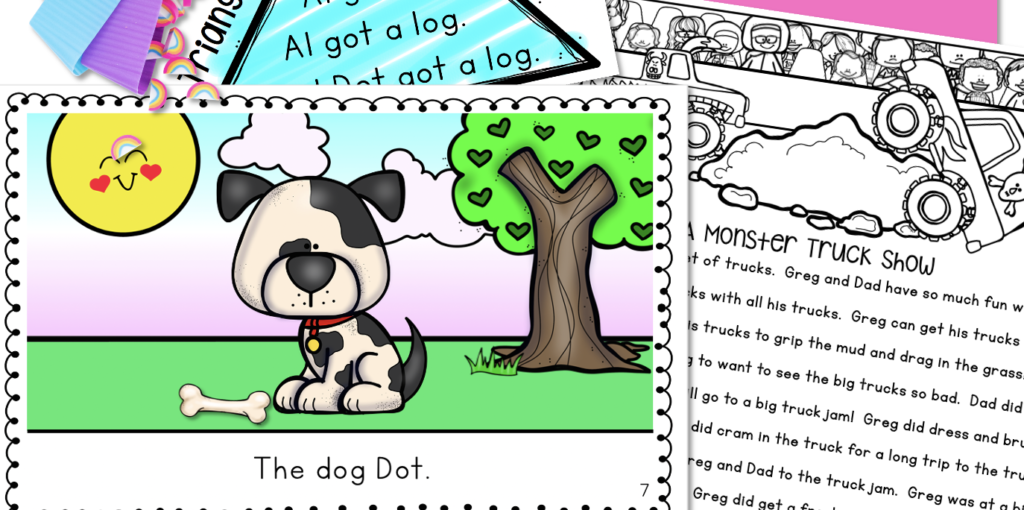
For example, the reader Tad and Dot focuses on short a and short o sounds and uses a very controlled text that contains words such as:
- cat
- dog
- tag
- odd
- Tad
- Dot
Students are able to practice decoding using only a small set of previously taught letter-sound correspondences rather than guessing words from pictures or context.
This is exactly what we want. Decodable text provides successful practice opportunities that strengthen the connection between phonics instruction and actual reading.
Step 3: Start with Phonemic Awareness
Before students even open the book, spend a few minutes working with sounds.
Phonemic awareness activities help students hear and manipulate the sounds in spoken words, which supports later decoding.
In the companion lesson plans, students practice identifying beginning sounds before reading. Activities build systematically and review previously learned skills while introducing new ones.
This quick warm-up helps students activate the exact skills they’ll need when they begin reading.
Step 4: Review the Focus Phonics Skill
Next, explicitly review the phonics pattern students will encounter in the text.
For the Tad and Dot reader, students review short a and short o sounds through multisensory activities, word reading, spelling, and application practice.
One thing I love about the bundle is that the phonics practice is scaffolded across the week:
- Day 1: Multisensory review
- Day 2: Reading and spelling words
- Day 3: Reading and spelling phrases
- Day 4: Reading and spelling sentences
- Day 5: Assessment and review
This gradual release gives students repeated exposure while keeping practice purposeful.
Step 5: Teach Heart Words Through Orthographic Mapping
Many beginning readers encounter common words that contain spellings they cannot fully decode yet.
Rather than asking students to memorize these words, use orthographic mapping to help them permanently store the words for automatic retrieval.
In the Tad and Dot lesson sequence, students practice mapping and reviewing the heart words the and and before encountering them in the text.
When students connect sounds, spellings, and meanings together, word recognition becomes more automatic and less dependent on memorization. You can read more about orthographic mapping here!
Step 6: Preteach Important Vocabulary
Even simple decodable texts contain words that may be unfamiliar to students.
For example, one vocabulary word introduced before reading Tad and Dot is odd, meaning something unusual or funny to see.
Preteaching vocabulary supports comprehension and allows students to focus their energy on decoding while still understanding the text.
Step 7: Read the Decodable Text
Now it’s time for the book.
The lesson plans intentionally spread the reading across several days:
- Day 1: Introduce the book and discuss the cover
- Day 2: Read the first half
- Day 3: Read the second half
- Day 4: Reread and answer comprehension questions
- Day 5: Reread and assess
This structure gives students multiple opportunities to interact with the same text while building accuracy, confidence, and fluency.
As students read, listen carefully for teaching opportunities. Notice what they do well and where they need support. Immediate feedback during connected text reading can be incredibly powerful.
Step 8: Focus on Comprehension
The Science of Reading is not just about decoding.
The goal of reading is comprehension.
Each reader includes comprehension questions that encourage students to think about what they read and return to the text for evidence.
Even in a simple text like Tad and Dot, students can discuss:
- Who the characters are
- What happened in the story
- What made the animals “odd”
- How details in the text support their answers
This helps students develop comprehension habits from the very beginning of their reading journey.
Step 9: Use Assessments to Guide Your Next Steps
One of the most valuable parts of effective small groups is using student performance to plan future instruction.
The bundle includes:
- Running records
- Phonics assessments
- Dictation opportunities
- Anecdotal note pages
- Comprehension tracking tools
These assessments help you identify exactly what students have mastered and what skills still need targeted instruction.
Rather than teaching the same lesson to every group, you can use assessment information to continually adjust instruction based on student needs.
Why This Routine Works
Strong Science of Reading instruction addresses multiple strands of skilled reading development.
Instead of treating phonemic awareness, phonics, heart words, vocabulary, fluency, and comprehension as separate activities, this instructional routine connects them together.
Students learn the skill.
They practice the skill.
They apply the skill in a connected text.
Then they demonstrate understanding.
That sequence is what helps new learning stick.
You have got this!
Decodable readers are most effective when they are part of a complete instructional routine.
By grouping students according to their needs, selecting texts that match their phonics skills, and intentionally teaching phonemic awareness, phonics, vocabulary, orthographic mapping, fluency, and comprehension, you can make every small group session purposeful and impactful.
The goal isn’t simply getting through a book.
The goal is to help students become confident readers who can successfully connect sounds, letters, words, and meaning.

No Comments