
September is the perfect time for all things apple! Apple activities for elementary students are a great way to seamlessly bring a seasonal theme into your lessons while still working on the skills your students need.
If you are looking for some low-prep, fun, and worthwhile learning activities for your students, then this is the blog post for you! From literacy and math to science and writing, there are so many easy ways to bring apples into your classroom this fall.
Read on for some of my favorite apple activities for lower elementary students!
Apple Activities for Literacy
You can incorporate almost any subject into reading and writing, and apples are no exception! But making it worthwhile and aligned to your standards—something that will actually help your students progress and move the needle—is a bit more challenging.
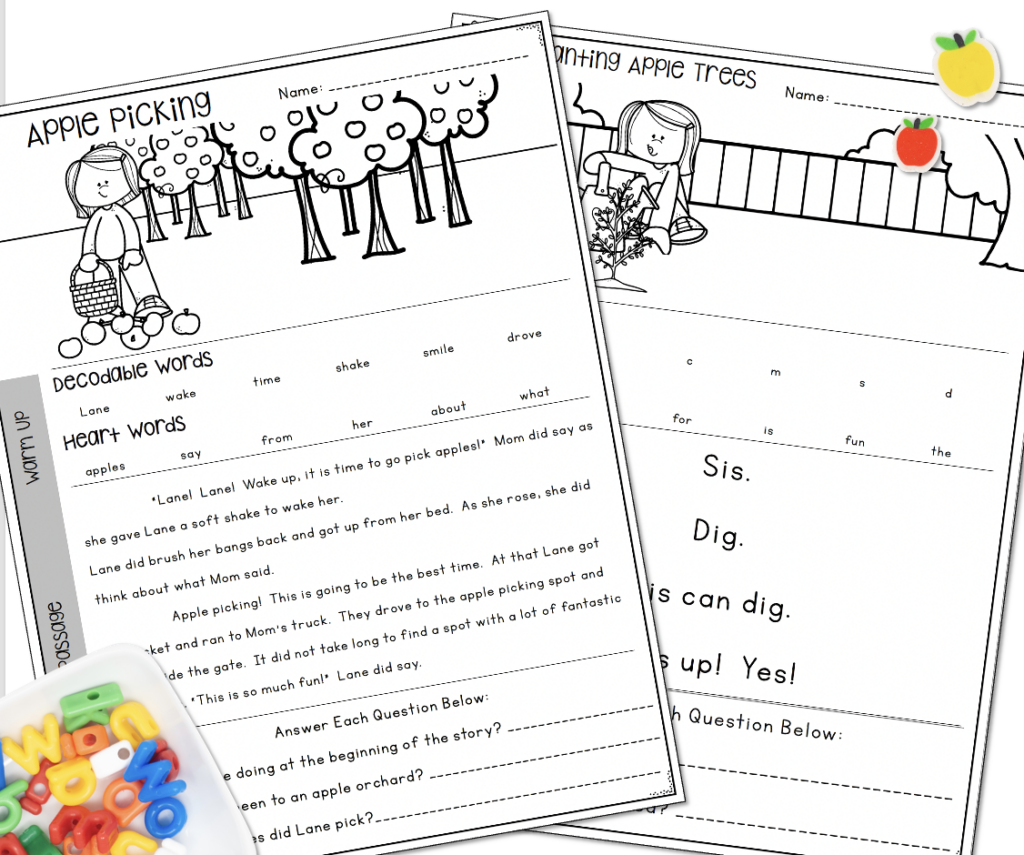
Apple-Themed Decodable Reading
This is something to consider when planning seasonal activities for my own classroom.
It is important to make learning fun and bring in the seasons, but not give up the important reading practice students need just because it’s apple week.
For beginning readers, I especially want reading practice to give them a chance to apply the phonics skills they have already been learning. That’s why I love using decodable texts during small groups and independent reading practice.
The challenge? Finding apple-themed decodable texts that are actually appropriate for beginning readers.
That’s one reason I created my Apple Reading Activities: Decodable Passages with Comprehension Questions. Instead of trying to squeeze a cute apple activity into my phonics instruction (don’t get me wrong, we do write in apple sauce and then all the fun apple picture books come later in read-alouds), I can use the apple theme while still giving students meaningful reading practice.
I especially love having three levels because it makes it easier to use the same seasonal theme with students who are working on different skills.
You can use the passages for:
- Small-group reading
- Independent reading practice
- Fluency practice
- Reading centers
- Intervention
- Whole-group practice
- Fluency practice
If you are looking for an easy way to add some apple fun to your reading block without giving up your phonics instruction, you can take a peek at the Apple Decodable Reading Passages here.
Apple Taste-Test and Writing
Which one do you like better—red apples, green apples, or yellow apples?
That’s a question I love to ask my kindergartners!
You don’t need much to turn an apple taste test into a simple literacy activity. Pick up a couple of different apples and cut them into tiny pieces so students can taste each variety.
As students taste the apples, talk about what they notice. Is one sweeter? Is one more crunchy? Do they like the red apple better than the green one?
Then let students choose their favorite.
For beginning writers, you can keep the writing simple:
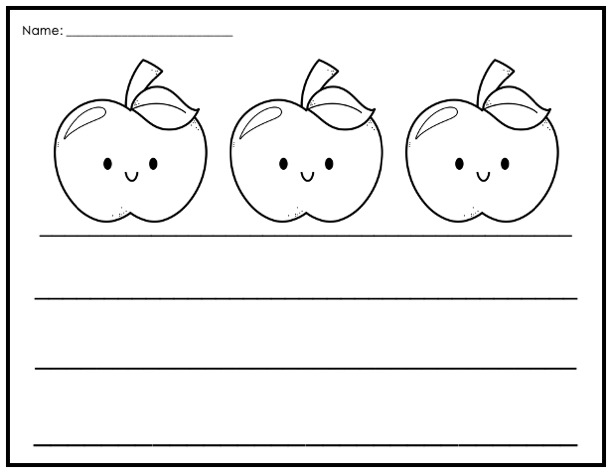
My favorite apple is ______.
More advanced writers can add a reason:
My favorite apple is ______ because ______.
I also love letting students finish their writing with a fun apple stamping activity using the color of their favorite apple.
Want to try this activity with your class? I created several different writing papers that would be great for this activity!
Apple Vocabulary
You can also use apples to build vocabulary with your students.
Introduce words such as:
- apple
- stem
- leaf
- skin
- seed
- core
- tree
- orchard
- farmer
- harvest
For younger students, have them draw and label the parts of an apple. Older students can use the vocabulary words in sentences or write a short paragraph about how apples grow.
Apple Activities for Elementary Students in Math
Apples make great math manipulatives because they are easy to count, sort, compare, and use in simple story problems.
And honestly, I love any activity that lets my students practice important math skills while they are also getting to do something hands-on!
Here are a few simple apple math activities you can try with your students.
Apple Counting Collections
Counting collections are one of my favorite ways to help young students build number sense.
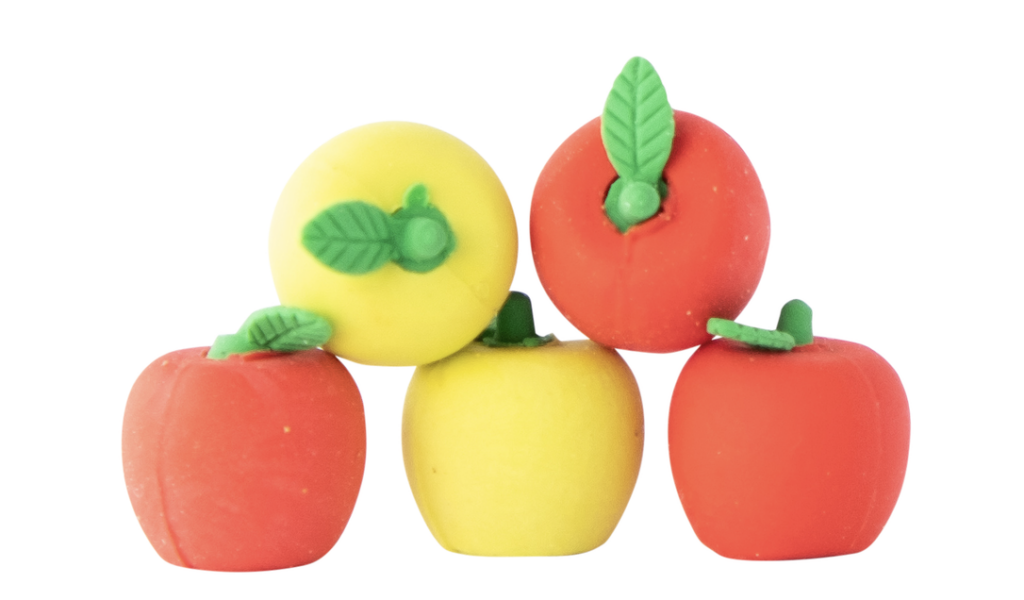
For an apple-themed counting collection, give students a small group of apple counters, paper apples, or even plastic apples. Have students count their collection and then represent the number in different ways.
Depending on your students’ skills, you might have them:
- Count the apples and write the number.
- Make groups of 5 or 10.
- Draw their collection.
- Build the number with cubes.
- Write a number sentence.
- Compare their collection with a partner’s.
- Find one more or one less.
- Organize their apples into a ten frame.
The great thing about counting collections is that you can easily differentiate them. One student might be working with a collection of 12 apples while another student is ready to count a collection of 35 or 50.
And if you teach first grade, this is a really fun way to bring a seasonal theme into your math block without losing sight of the skills you’re already working on.
I actually created an entire apple-themed counting unit as part of my first grade math curriculum. It gives students opportunities to practice counting and building numbers while working with a fun apple theme.
You can check out that complete unit here!
Apple Addition
Those same apple counters can easily become addition manipulatives.
Give students two groups of apples and have them combine the groups to find the total.
For example:
🍎🍎🍎 + 🍎🍎 = ?
Students can physically put the apples together, count the total, and then write the corresponding addition sentence.
For students who are ready for more, turn the activity into simple apple-themed story problems:
Mia has 4 red apples. Her teacher gives her 3 more apples. How many apples does she have now?
Students can use counters, drawings, or equations to solve the problem.
Apple Subtraction
You can use the same materials for subtraction!
Start with a group of apples and have students “take some away.” This gives younger students a concrete way to see what subtraction means.
For example:
🍎🍎🍎🍎🍎
“Sam has 5 apples. He gives 2 apples to his friend. How many apples does Sam have left?”
Students can physically remove two apples, count what remains, and then write the subtraction equation.
Comparing Apple Collections
Apple collections are also perfect for practicing more than, less than, and equal to.
Give two students different collections of apples. Have them count each collection and compare the amounts.
Ask questions such as:
- Who has more apples?
- Who has fewer apples?
- How many more?
- How many fewer?
- Are the amounts equal?
For first graders, you can take this a step further by having students use the greater than, less than, and equal signs to compare numbers.
Apple Graphing
And, of course, we can’t forget an apple taste-test graph!
After students taste red, green, and yellow apples, have them vote for their favorite.
Create a simple class graph and let students help record the results.
Then ask questions such as:
- Which apple was the most popular?
- Which was the least popular?
- How many students chose red?
- How many students chose green?
- How many more students chose red than yellow?
One simple activity can give you opportunities to practice counting, comparing numbers, and talking about data.
Apple Patterns
Don’t forget about patterns!
Use red, green, and yellow apples to create simple patterns for students to continue.
For example:
Red, green, red, green, ___
Once students understand simple AB patterns, challenge them with more complex patterns such as ABC or AAB.
You could use colored paper apples, linking cubes, plastic counters, or even crayons to create the patterns. No fancy materials required!
Apple Activities for Science
Apples are also a great way to sneak a little science into your September lessons.
What Is Inside an Apple?
Cut an apple open and let students observe what they see.
Before cutting it open, ask students what they think they will find inside. Record their predictions on chart paper.
Then cut the apple open and investigate!
Students can observe the:
- Skin
- Flesh
- Seeds
- Stem
- Core
For kindergarten students, this can be as simple as drawing what they observe. Older students can label the parts of the apple and write about their observations.
Will an Apple Sink or Float?
This is one of my favorite easy science experiments because you only need an apple and a container of water.
Before putting the apple in the water, ask students to make a prediction:
Will the apple sink or float?
Record their predictions, test the apple, and then discuss the results.
You can extend the activity by testing other classroom objects and making a simple sink-or-float chart.
Observe an Apple Over Time
Cut an apple in half and leave one half exposed to the air.
Ask students to observe what happens over the next few hours. What changes? What stays the same?
For older students, you could even have students record their observations at different times throughout the day.
This is an easy way to practice making observations and recording what students notice.
More Simple Apple Activities for Elementary Students
Sometimes the best activities are the ones that don’t require a ton of preparation.
Here are a few more simple ideas you can squeeze into your September lessons:
Apple Letter Practice: Give students paper apples and have them write letters, beginning sounds, or sight words on each apple.
Apple Number Match: Write numbers on paper apples and have students match them with the corresponding number of seeds or dots.
Apple Descriptive Writing: Put an apple where students can see it and have them use their senses to describe it. What does it look like? Feel like? Smell like? Taste like?
Apple Books: Read an apple-themed picture book and have students respond with a drawing, sentence, or simple comprehension activity.
Apple Sorting: Give students red, green, and yellow apples and have them sort by color, size, or another attribute.
The possibilities are really endless!
Making Apple Activities Work for Your Classroom
The best part about using a theme like apples is that you don’t have to completely change your curriculum to make it work.
Instead, look at the skills you are already teaching and ask yourself how you can add a little apple fun.
Are you working on counting? Count apples.
Are you practicing addition? Add apples.
Are you learning about beginning sounds? Find the beginning sound in apple or use apple-themed pictures.
Are you practicing writing? Let students write about their favorite apple.
Are you working on making observations in science? Investigate an apple!
You can keep your instruction focused on the skills students need while using a seasonal theme to make learning a little more engaging.
And if you are anything like me, low-prep is always a win!
Final Thoughts
September can be such a busy month in the elementary classroom. You are teaching routines, building relationships, assessing students, and trying to get everyone settled into the school year.
That’s why I love simple seasonal activities that don’t require hours of extra planning.
These apple activities for elementary students are easy to work into your existing lessons and give you plenty of opportunities for hands-on learning across multiple content areas.
So grab a few apples, some paper, and whatever supplies you already have on hand—and have a little fall fun with your students!
Happy teaching!


No Comments